5 games for kids ages 5–10 that secretly teach
Which games suit your child's age? Here are 5 picks that blend fun and learning seamlessly.
21 May 2026
The right challenge for every age
A game that is too easy gets boring fast. One that is too hard leads to frustration and giving up. The key lies in the zone of proximal development — the sweet spot between "I already know this" and "this is impossible." That is exactly where real learning happens.
Researchers at MIT call this state "hard fun" — the challenge is big enough to be interesting, but not so big it discourages. That is the secret of good educational games: fun and learning are not opposites — they are the same thing.
Here are 5 games that hit that mark — all available on Nafoo.
1. Quiz (ages 6+)
Perfect for primary-school children. Questions about animals, science, geography, and many other topics, grouped by difficulty. The child doesn't feel like they're studying — they feel like they're playing. And yet, they are learning. Every wrong answer is an opportunity to discover something new immediately, in a way that makes it stick.
What it builds: general knowledge, quick thinking, confidence.
Parent tip: play along — let your child "beat" you sometimes, and discuss the correct answers together. The conversation around the game teaches just as much as the game itself.
2. Word Puzzle (ages 6+)
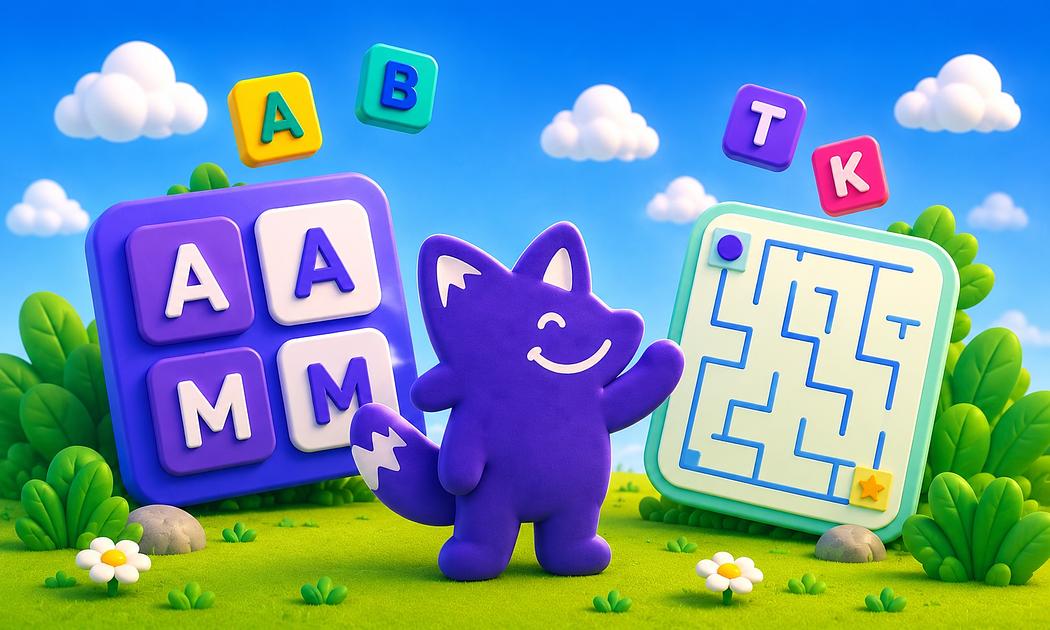
The child searches for hidden words inside a letter grid — horizontally, vertically, diagonally. It feels like a treasure hunt, and it builds Greek reading and spelling skills in a completely natural way, with no worksheets and no sense of obligation. Children who struggle with spelling often find that this game helps — because spelling becomes a tool, not an end in itself.
What it builds: spelling, letter recognition, visual focus.
Parent tip: ask your child what each word they find means — it is a great opportunity to expand their vocabulary in a way that feels nothing like a lesson.
3. Memory — for two (ages 5+)
Match card pairs by taking turns. This game works perfectly for two players on the same tablet — no internet connection needed, no second device required. It suits children from age 5 and makes an excellent parent-child activity. Beyond memory, it also builds social skills: waiting your turn, losing without overreacting, winning without gloating.
What it builds: short-term memory, concentration, patience, social skills.
Parent tip: if playing with a younger child, start with fewer cards — early wins build confidence and make the child want to play again.
4. Maths (ages 6+)
Simple operations — addition, subtraction, multiplication — against the clock. The competition is not against other children, but against themselves: "can I beat my score from yesterday?" That internal challenge is far healthier than comparison with classmates — it keeps children motivated and focused without creating anxiety.
What it builds: arithmetic, mental processing speed, self-discipline.
Parent tip: check the score together and celebrate every improvement, however small. "You're better than yesterday" is one of the most powerful things a child can hear.
5. Maze (ages 5+)
Find the path from start to finish. The maze is one of the oldest puzzles in human civilisation — for good reason. It forces the brain to plan ahead, try, fail, and try again. There is no random strategy — you either think it through or you get stuck. This game teaches persistence better than any piece of parental advice.
What it builds: spatial thinking, logic, persistence, confidence.
Parent tip: resist the urge to help too quickly — the moment a child finds the exit on their own is one of the most powerful confidence-builders there is. Instead of pointing to the solution, try asking: "what have you tried so far?"
All of the above games are available on Nafoo — free, no ads, designed for children ages 5–10 growing up with Greek.
Discover Nafoo's free educational games.
Play now →